Babywearing safety
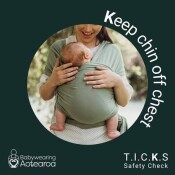
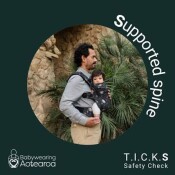
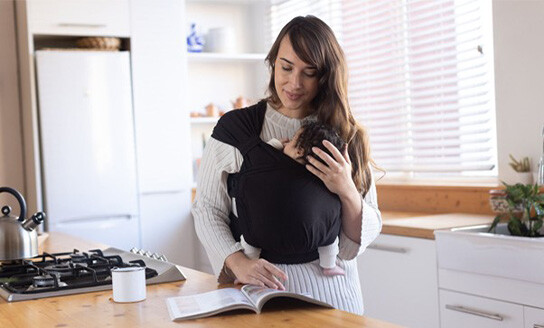
A safe baby carrier supports your pēpi in the position you naturally carry them in your arms. The carrier needs to be a suitable size, with baby able to breathe clearly and their back and hips well supported.
Unsafe babywearing occurs when the carrier is too big or worn in a way that covers baby’s face or head or holds them in an unsafe position. They can be at risk of falling from the carrier or suffocation. Babies are unable to move themselves out of dangerous positions that block their airways, so it’s essential you position them correctly and always watch them closely while they’re in a carrier.
Carrier safety guidelines
- pēpi needs to be continuously monitored
- the carrier holds pēpi securely in an upright position so that they can’t slump down or fall out
- you can see baby’s face is clear at all times
- baby’s chin is off their chest so airways are not compromised
- you wear the carrier high enough so baby’s head is on the firm part of your chest
- baby’s spine is supported in a natural position and hips are well supported
- you hear the buckles click closed or have used a double knot
- always put one hand on pēpi if you are bending over
- take extra care with pēpi under 4 months and preterm or unwell babies
- if breastfeeding in the carrier reposition after the feed so the head is up, clear of fabric, and the airway is not obstructed by your body
- always follow the manufacturer’s instructions.
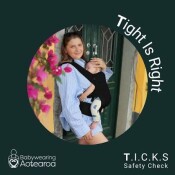
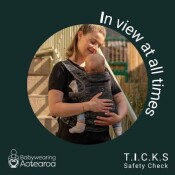
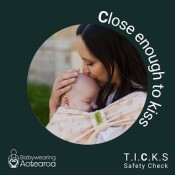
There are many different ways to describe how to ensure babywearing is safe, including the TICKS guidelines and phrases like ‘High, Tight & In Sight’. The TICKS guidelines are often included in carrier instructions and are shown below. TICKS was created by the UK Sling Consortium and updated by The Pathways Foundation to include healthy hip placement.
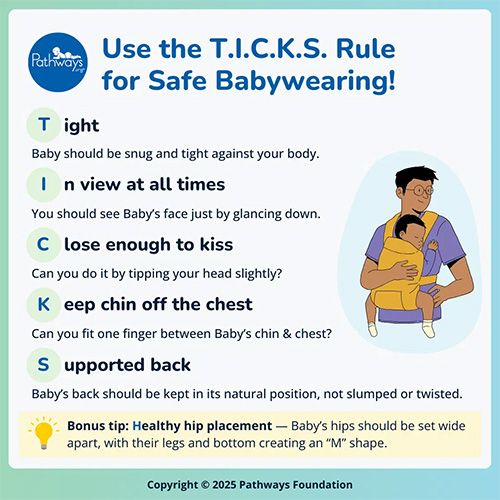
Image credit: Pathways Foundation
Carrier size matters
While carriers are often advertised as suitable for newborn babies (from 3.2kg), many are hard to get a safe fit as the back panel is too tall. Your carrier needs to always be worn below baby’s ears to ensure their face is clear. Lifting the waist band to just below your ribs may help reduce the height of the panel. However, some carriers are much safer and a more comfortable fit from about 3-4 months.
Risk factors
While using a baby carrier is usually safe, tragically there have been a small number of suffocation fatalities overseas. These have occurred when pēpi has not been able to breathe due to their position in the carrier, their face being covered, airways compromised by illness and not being continuously monitored. Caregivers need to be particularly careful during the first 4 months, when pēpi is unwell, and with any preterm babies. Baby’s face must always be clear, uncovered, and continually monitored.
- Never cover baby’s airways with the carrier, clothing, jackets, or fabric like muslin or blankets.
- Do not lie baby sideways in a carrier which risks pushing their chin down and cutting off their airways.
- Do not breastfeed hands-free, or leave pēpi unmonitored or pressed against or under the breasts.
- Take extra care using a carrier when baby is under 4 months, or when unwell, especially with respiratory illness when their airways are already compromised.
Parents and carers need to take extra care when using baby carriers for babies that were premature, are under four months old, suffer from any breathing difficulties, are unwell, or weigh less than 4kg.
About babywearing
Babywearing, or carrying a baby in a wrap, sling, or carrier, has been practised around the world for centuries.
Baby carriers are not a new invention, but designs have evolved a lot over the years. Most baby carriers are designed to be hands-free, more comfortable and supportive than carrying a baby in your arms. A well-designed carrier also distributes the weight of pēpi across your body and reduces the strain on your shoulders and lower back.
What are the benefits of babywearing?
Babywearing:
- leaves your hands free to do whatever you need to do
- gives you lots of skin-to-skin contact with your pēpi
- strengthens the bond between parent/caregiver and baby
- allows babies to see the world from up high
- may help babies fall asleep easier with the rocking or walking motion
- pēpi gets quality tummy time on you
- offers a practical way for fathers to be closely involved in baby settling
- makes walking, public transport and busy places more practical with a baby.
Choosing a baby carrier
There are many different brands and types of baby carriers available in New Zealand, so choosing one can feel overwhelming. There’s no one ‘best carrier’ and what suits you might be quite different to what your friends use. There are also options that might be more affordable and more comfortable than the common models of buckle carriers. We recommend researching and finding a carrier that fits within your budget and:
- allows for a baby’s back to be supported in its natural position
- allows for the relaxed baby’s legs to be in the spread-squat position
- allows the wearer to distribute the baby’s weight comfortably across their own body.
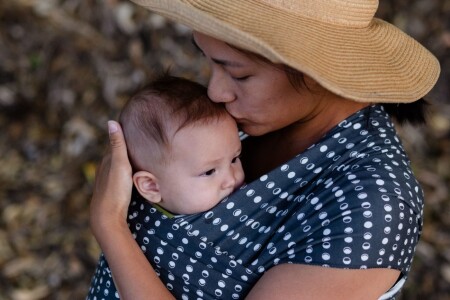 It’s important to note that there are no safety standards for baby carriers in New Zealand, so not everything you find for sale is safe or comfortable. We recommend choosing a carrier that meets either the UK or US safety standard, and that you buy from a reputable retailer with trained staff.
Many communities around New Zealand have local babywearing groups or babywearing consultants that offer the opportunity to try before you buy. Their expert advice can also help with selecting a suitable carrier for what you want to use it for and what will be most comfortable for you.
Be wary of purchasing baby carriers from overseas discount websites and second-hand marketplaces. If in doubt, ask to see the original purchase receipt before buying a new or second-hand carrier if the price seems too good to be true. You can also seek guidance from a local babywearing group if available.
If you are shopping for a baby carrier in-person, take your baby with you or try a carrier with a babywearing demo doll of a suitable size. If your partner is going to wear the carrier too, it needs to be adjustable to fit both of you. If the shop assistant can’t tell you about it and show you how to use it safely, go somewhere else.
For baby's safety and comfort:
- check the recommended age and weight to make sure the carrier is suitable for your child
- check the carrier back panel is no higher than the bottom of baby’s ears
- check that it will support your little one’s hips and legs in the recommended ‘M’ position for health hip development, with the fabric supporting them to the back of each knee
- check your baby’s airways are not covered when the carrier is fitted
- check that the carrier provides support for the baby’s spine, right up to the back of the neck for a young baby, and that it holds your baby securely
- make sure the straps don't cut into the baby’s face or get in the way of their vision
- breathable fabric will help keep baby cool in summer (but you’ll need to dress your pēpi warmly in cooler weather).
For your comfort:
- broad shoulder straps will help distribute the baby’s weight. The straps need to sit comfortably without pulling on your neck or shoulders
- a comfortable waist band will take some weight off your shoulders and limit sideways movement of the carrier, adding stability
- it's best if you can easily adjust all straps with one hand
- straps that tie up are more adjustable and can be more comfortable for some adults, whereas some people find clips and buckles easier to use.
DO NOT choose a carrier if:
- the back panel goes over your baby’s head – it’s too big for your pēpi
- your baby lies with their face pressed against the fabric
- it is described as being like a cocoon (that means your baby would be lying with a curved back, their chin resting on their chest)
- it’s described as womb-like, or it places the baby in the foetal position
- it is a bag sling, with a drawstring that closes over your baby and cuts the airflow (not to be confused with a ring sling).
Types of baby carriers
There are many different kinds of baby carriers.
Ring slings
Ring slings are a strip of fabric, normally worn across your front and secured over your shoulder with 2 metal rings. Ring slings are used like a hammock seat with fabric that supports them to be held against your chest and can be tightened for a secure carry. Suitable from newborn when worn correctly.
Wraps
Wraps are a long strip of fabric that wraps around the body of the wearer and child. They can be wrapped in many different ways to have pēpi on your front, hip, or back. Wraps can be either stretchy (suitable from younger pēpi) or woven (suitable for all ages). Suitable from newborn when worn correctly.
Buckle carriers
Buckle carriers are the most popular option in Aotearoa. They are simple to use and a versatile option, and most can be worn on your front and on your back. Some models can also be worn forward facing for short periods. They usually have shoulder straps and a waistband to help distribute your baby’s weight. Some models can be used from newborn.
Mei Dai
Meh Dai carriers are an Asian style carrier a similar to a buckle carrier with a back panel, however the shoulder straps and waistband are tied up instead of buckled.
A half buckle carrier is a mix of the two with a buckle waist and long shoulder straps that are tied up. Some models can be used from newborn.
Hip carriers
Hip carriers are a carry assist option simply designed to assist you to hold the weight of your little one without all of the weight being on your arms or hip. You keep your arm around your little one at all times holding them. These are suitable for babies/toddlers who can sit unassisted, from about 9 months.
Structured backpacks/hiking packs
Structured backpacks/hiking packs only go on your back and normally have rigid frames. You can’t put young babies in them as they don’t support your baby in an upright position – your baby needs to already have the core strength to hold themselves upright for long periods. These are suitable for pēpi and tamariki who can sit unassisted from about 9 months.
Forward facing guidance
Forward facing in a carrier is a popular option for whānau and possible in some models of baby carriers. It is safest to wait until closer to six months before having your pēpi face outwards in your carrier. Check your pēpi can tripod sit (sit independently using one hand) and have good head and neck control. Their chin must be above the carrier panel and airways to avoid suffocation.
It is not safe for babies to sleep in the forward-facing position, as they can slump forward and restrict their airways. It is also recommended to limit forward facing to 10-15 minutes at a time so as not to over-stimulate them.
Keeping your baby safe in a carrier
When you’re wearing a baby carrier, check that the baby’s face is clear, and the baby’s back is straight. Regularly check your baby for any signs of discomfort or distress.
If you see any of these things, remove the baby from the baby carrier or immediately reposition them:
- face covered or chin tucked in
- head turned to the side
- curled into a ‘C’ position
- grunting, wheezing, whistling breaths
- laboured or rapid breathing
- a dusky or ‘blue’ tinge on the baby’s skin
- ‘fussiness’, restlessness or squirming.
Other considerations
If you wouldn’t do something holding your baby in your arms, it is safest not to do it while wearing your baby in a carrier.
- take care around hot liquids, cooking or heat
- it's safe to use carriers around shallow water, but not in deep water – for example splashing or paddling, not for swimming
- never shake or bounce your pēpi while they’re in your carrier – don’t jump, or go jogging or running. Shaking a baby can damage their neck, spine, and/or brain
- never use a baby carrier while in a car – baby carriers don’t provide the protection car seats provide
- be aware of what your pēpi can reach – especially if they’re in a back carry and you can’t see them
- constantly observe your pēpi while they’re in the carrier to make sure they’re in a good position and getting a good flow of air
- protect your pēpi from the elements – dress them appropriately for the weather and remember a hat, umbrella or sunscreen in the summer
- don't use a carrier if you are intoxicated or under the influence of drugs.
Check your carrier regularly
It’s a good idea to regularly check your carrier is still safe and comfortable to use by making sure:
- inside seams don’t rub or chafe your baby
- there are no sharp edges, choking hazards, small loops or buckles to trap little fingers and toes
- the carrier is still in good condition with no ripped seams, compromised stitching, loose or missing buckles.
Baby slings
Where to go for help with your carrier
New Zealand has many babywearing experts who can support you in your carrying journey:
- your local Babywearing library/group
- babywearing consultants
- Babywearing Aotearoa.
Need support with sleep and settling?
Call PlunketLine free on 0800 933 922 to speak with one of our friendly nurses. We also offer free, private online appointments with nurses specially trained in sleep and settling support for your pēpi.
