For many parents, the first months with a new baby is a huge change that can feel like a blend of love and exhaustion. Sometimes it can be overwhelming.
Anxiety can take over. A difficult birth may keep replaying. Sleep all but disappears, confidence starts to slip a bit and self-doubt can creep in. Simple daily tasks that once felt manageable suddenly feel enormous. And when you’re caring for a baby, it isn’t always easy to find the time to ask for help or even know where to find support.
That’s where Plunket’s wraparound care and mental health support services make a huge difference, with the latest being our Online Perinatal Wellbeing Service (OPWS).
It provides free, online mental health and wellbeing support for parents and caregivers experiencing mild to moderate distress, anxiety or depressive symptoms while caring for children aged up to five.
A place somewhere between coping and crisis
Plunket’s mental health services are designed to fill an important gap.
In Aotearoa, up to 18% of mothers and around 10% of fathers experience mental health challenges during pregnancy and the early years of their child’s life. Many are not unwell enough for public specialist care, but also not well enough to cope on their own. And the cost of private support is out of reach for many families.
"When māmā don't get help in their most challenging times, they can get to a point where they become suicidal and take their own life," says OPWS practitioner, Alex Murray. "And suicide is the main cause of maternal mortality in New Zealand. So we know what can happen when mums don't get the support they need."
Plunket supports stretched public services by helping these mums and dads early, before things reach such a crisis point.
The need is clear. Having only launched in March of this year, the new service is receiving two to three referrals a day. Families have typically been waiting around four to six weeks for an initial assessment.
"We are well beyond what was anticipated in terms of numbers and referrals," says Alexandra Dolhoun, another OPWS practitioner. "We fill our day as tightly as we can, while also working in breaks to give our own nervous systems a rest...it can be energetically taxing. But it also, in a way, fills you up."
Support that comes to the parents, where they need it.
One of the simplest things about OPWS is also one of its strengths: it happens online.
For a parent with a baby at home, that matters. There’s no long, stressful travel across town with a newborn, or trying to find childcare in the middle of the week. There’s no sitting in a waiting room wondering whether you really have time for this, especially if there are older tamariki needing you.
Instead, support happens from the comfort of home and around the realities of family life.
For māmā Kelsi, the convenience of being able to join her session with Alexandra from home meant she could make the most of the time. "It made me feel a lot more relaxed going into the sessions."
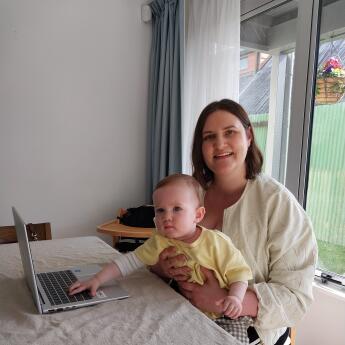
Kelsi and Ardie have been able to enjoy sessions from the coziness of home.
"Our initial assessments are really about getting to know the parent and actually asking them about their lives and their children, their birth experience," says Alexandra. "We use a psychosocial wheel of health to explore all of the factors that can influence wellbeing, not only in the person but specifically in the parenting journey. It helps clients generate ideas of where their strengths and struggles are, and it's a beautiful way for clients to think differently."
That might mean working on anxiety or depression. It might mean processing a difficult birth, strengthening parenting confidence, improving communication with a partner, learning ways to manage stress, or connecting with other services and support.
Sometimes it is about helping a parent find their way back to themselves.
"It’s a very human experience," Alexandra continues. "That's what everybody wants – to be heard, and to be seen."
She says a lot of clients will come to the end of the first session and say "that's not at all what I was expecting! It was really cool!"
The team brings together different perspectives, including therapy and nursing, and can look beyond a diagnosis to the wider picture of someone’s life to create a treatment plan.
There might be therapeutic work, relaxation and body-based approaches, parenting support, practical problem-solving or help with navigating other services.
“It’s much more holistic,” Alex says. It feels human. "We don't focus on diagnosis," she says. "We focus on the challenges and then we get to address the challenges – I get to use my creativity. And it doesn't require anything other than a camera and a willing participant."
For Kelsi, the tailored, 'human' approach to mental health support from Plunket was crucial. Pregnancy and birth were difficult, and her baby, Ardie, spent four days in NICU.
In those early months, anxiety and uncertainty became overwhelming. She worried she wasn’t a good mum and felt uncomfortable asking for help because she didn’t want to burden the people around her.
Her Plunket nurse referred her to Plunket’s mental health service, where she worked online with Alexandra.
Together, they explored workable strategies for managing anxiety and resetting when things felt too much, alongside the wider pressures affecting her wellbeing. Kelsi was also managing endometriosis and PMOS, which Alexandra was able to support with practical nutrition tips that could be fit into Kelsi's life in a very real way.
Over time, things began to change. Motherhood hasn't suddenly become easy. But Kelsi has found more confidence in herself and more space to enjoy it.
Looking back, she says she never would have imagined that those difficult first months could become something so different.
Learn more about Kelsi's full story
Meanwhile, for māmā Ali'sha, truly connecting with her Plunket mental health practitioner was key. "When you're being overtaken by anxiety, it can be hard to open up, especially in regards to how you're feeling about being a mum," she says. "You start to worry and think 'will he get taken away from me because I'm struggling mentally?'" But, she says, that never crossed her mind while working with Alex M. "I just knew she was a safe place. And we'd laugh a lot, which I really appreciate."
Ali’sha’s baby was born prematurely after complications during pregnancy and spent 21 days in hospital on breathing support. When they finally came home, the uncertainty didn’t disappear.
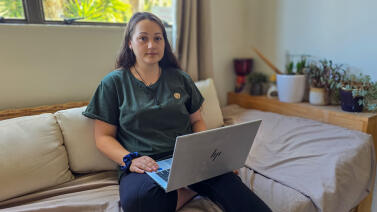
Ali'sha found the online format of her OPWS sessions meant at-home comfort while discussing challenges with her postnatal anxiety and depression.
Ali’sha found herself consumed by anxiety. For months, she carefully tracked every feed, every nappy change and every bit of sleep, while constantly worrying if something was wrong. If she was doing something wrong.
Her Plunket nurse referred her to our specialist team. "She was experiencing birth trauma, postnatal depression and postnatal anxiety. The full combo," reflects Alex M. "We crafted a care plan for 8 to 12 sessions and worked through that. But the thing that was special is that we connected.
"The therapeutic relationship is super important."
The rapport they developed and the safe place that Alex became for Ali'sha gave her space to understand what was happening, work through the impact of her birth experience, and recognise the patterns of catastrophic thinking that were fueling her anxiety.
Slowly, she ‘came back to herself’.
Helping one parent helps a whole whānau
When a mum or dad is struggling, it can affect relationships, confidence, parenting and the wider family. So when that parent gets the right support, the benefits can reach well beyond the individual.
Alexandra and Alex M describe early intervention as an opportunity to strengthen the whole family.
Supporting a parent can help them feel more confident and emotionally available. It can help partners understand what is happening and find better ways to support one another. And it can give caregivers practical tools for responding to the everyday realities of raising a young child, from exhaustion and overwhelm to tantrums and unsettled nights.
Positive experiences and relationships in early childhood help shape development, attachment, emotional regulation and later wellbeing. Early support can strengthen a family’s protective factors before challenges become more entrenched.
Alex M says that research shows that if a mother commits suicide, their children are three times more likely to do the same.
"Work [with] the māmā, and you [could] prevent that from happening to them. Essentially, you're not only contributing to save the mum's life but the lives of their children, grandchildren, and so on."
In other words, helping early can change what happens next.
We’re already seeing the difference
The numbers from OPWS tell part of that story.
In the most recent quarter, the service delivered 100 individual therapeutic sessions and 17 group sessions. Of the people who completed care, 85 per cent showed improvement in their depression and anxiety scores, while a further 15 per cent maintained similar scores without decline.
And Kelsi and Ali’sha’s stories show the tangible outcomes. Plunket's maternal mental health supports parents to find space, to pause, make sense of what they’re feeling, learn practical tools, build confidence and reconnect with the people and things that matter to them.
It's catching struggling māmā before they fall through the gaps.
And every one of these parents who gets Plunket support early has a better chance of moving forward with greater confidence, stronger relationships and more capacity to be there for their child.
As the mother of a young child herself, and having seen the incredible results so far, Alexandra reflects on OPWS and its impact on whānau: "I think this is my life’s work.”
How you can help the work continue
This Plunket Giving Day, you can help make sure that when a parent reaches out, there is someone there to meet them.
Your donation will help keep early, accessible mental health and wellbeing support available to parents who are doing their best to care for their babies and children — while finding their own way through a challenging season.
Donate this Giving Day and your donation will go twice as far - every donation will be matched dollar for dollar thanks to the Wright Family Foundation. Catch struggling māmā before they fall through the gaps.
